hydrac.instruments.aquascat
Aquascat instruments (hydrac.instruments.aquascat)
-
class
hydrac.instruments.aquascat.Aquascat(name)[source]¶ Bases:
hydrac.instruments.acoustique.AcousticAquascat instrument class.
Base class :
hydrac.instruments.acoustique.AcousticThe Aquascat is a multifrequency profiler working at the kHz-MHz frequency range developpe by Aquatec Group. Its full description is given in http://www.aquatecgroup.com/11-products/78-aquascat. The example of a Aquascat 1000R is shown below :
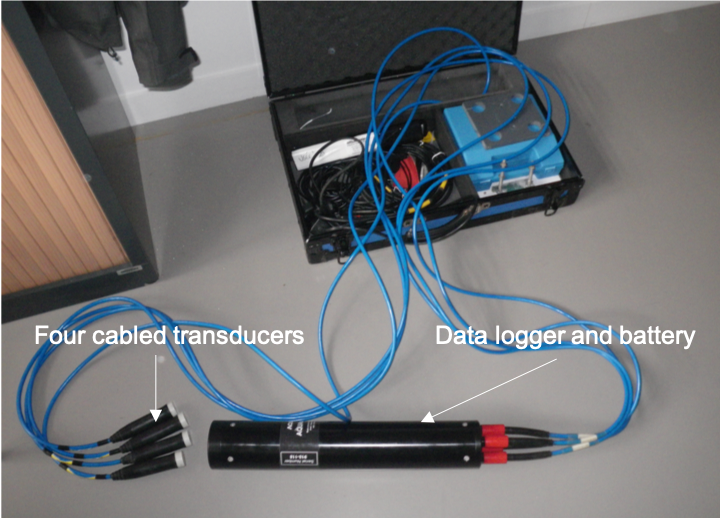
The Aquascat class reads the raw binary files from Aquascat instruments and stores the valuable information into the
parammodified dictionnary with the common shape handled by hydrac (seehydrac.instruments.acoustique).A typical example of how should the data considered is as follows
>>> A = Aquascat('Campaign_1')
The above line will prompt the user to select one or multiple files in a directory, read and store each file data into
paraminstanciated in :class: hydrac.instruments.acoustique.Acoustic, as separate modified dictionnariesPX, X being the file number. Ex: for the first file loaded inparam, one can look at the differents variables stored inparam.P0>>> A.param.P0.keys() dict_keys(['BurstTime', 'PingRate', 'NumPingsTot', 'NumChannels', 'NumProfilesSamples', 'NumAverage'...])
One also gets the base Acoustic class instance
instr_type:>>> A.instr_type 'acoustic'
Or methods:
>>> A.preproc_acoustic_data()
which will prompt the user for extra information necessary to the processing of the hydroacoutic data such as water temperature. See
hydrac.instruments.acoustique.Acoustic.preproc_acoustic_data()Parameters: - name : str, {‘Campaign_1’}
Tag name, for personal usage, for instance to add a campaign name.
-
param_shape_AQA(self, inp)[source]¶ Reshapes the modified dictionnary
paramto fit the standard key names and data shape used throughout hydrac
-
_set_calib_aqa(self)[source]¶ Calibration coefficients for each transducer are unique to each transducer. As such, each instrument comes with a different set of calibration coefficients Kt. Those are stored in xml file generated (if non-existant) or updated (with
_update_calib_aqa()) with the instrument serial number and the Kts. This xml is accessed/generated through the classhydrac.util.paramcontainer.ParamContainer.
-
_update_calib_aqa(self, a, b=None, remove_elem=False)[source]¶ Update the calibration xml file either by adding a new instrument or deleting the coefficients of a particular instrument. This xml is accessed-generated through the class
hydrac.util.paramcontainer.ParamContainer.Parameters: - a : str
Instrument serial number read from binary files and stored in
param.- b=None : dict
Contains the calibration coefficients, prompted by the user if the instrument is used for the first time in hydrac.
- remove_elem=False : bool
Removes the information relative to the serial number a in the xml.
-
batch_read(self)[source]¶ Read a list of .aqa raw Aquascat file using the method
read_AQA()
Classes
Aquascat(name) |
Aquascat instrument class. |